
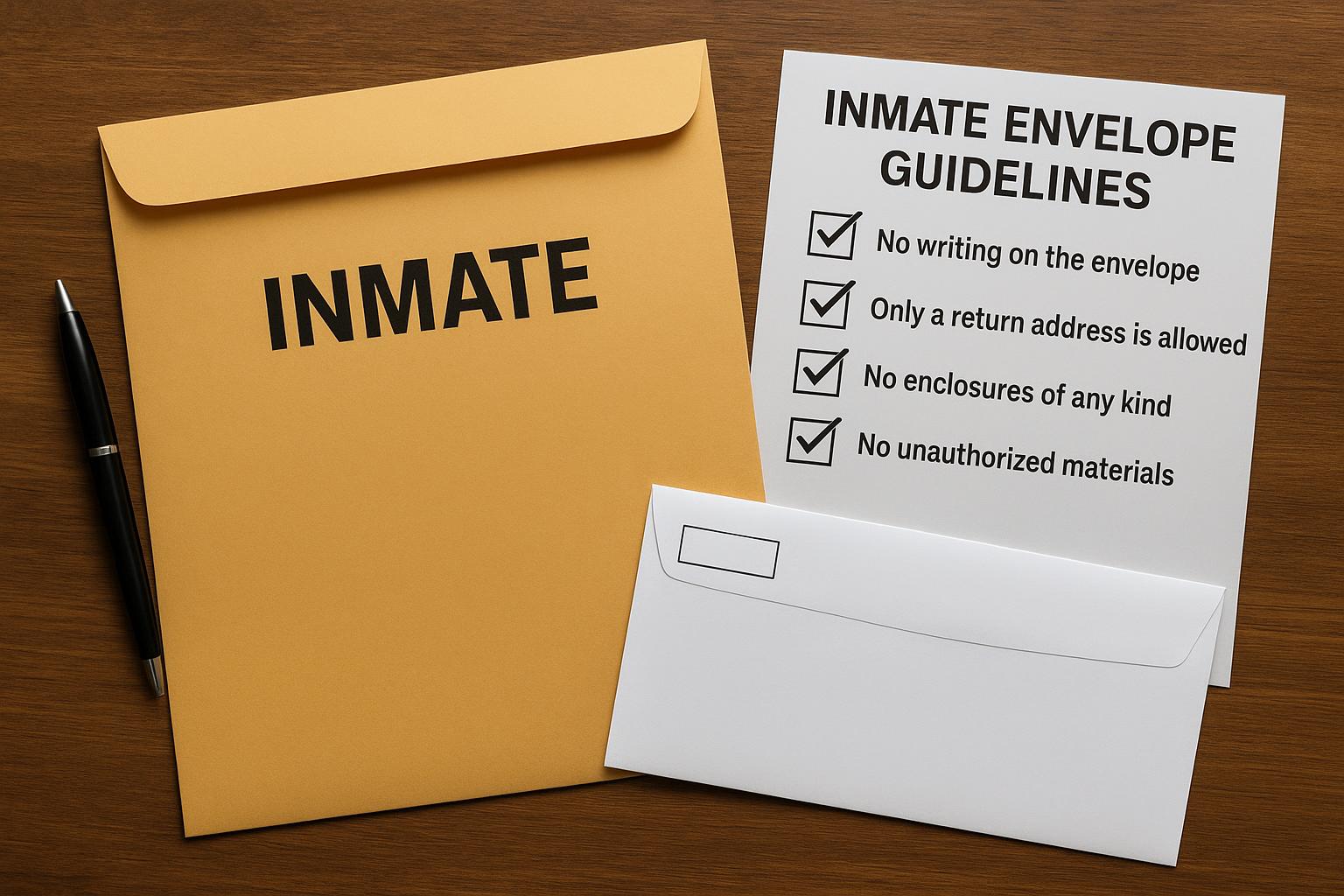
## Practical Inmate Envelope Guidelines For Mail Safety
Prison mail isn’t the same as sending a birthday card across town. Small choices — the type of envelope, how you write the address, what you include with the letter — change whether mail arrives intact, gets returned, or is held for weeks. These inmate envelope guidelines are meant to reduce frustration for both the sender and the person inside.
### Know The Purpose Behind The Rules
Corrections staff inspect mail to keep contraband out and to protect safety. That sounds obvious, but it explains a lot of the nitty-gritty rules: heavy paper can hide items; glued-on decorations can conceal slivers of metal; colored paper can carry hidden messages when layered. Understanding that the process is about security, not personal insult, helps you pick materials and formats that speed delivery.
#### How Mail Is Processed
Mail typically goes to a central unit for sorting, then to an inspection point. Photos are often run through an X-ray machine; packages get a closer look. If something looks suspicious, officers may open it according to facility policy. When you follow basic inmate envelope guidelines, the chances of delays drop sharply.
### Paper, Envelopes, And Printing: What Works
Pick plain, opaque materials. White or manila stock makes inspections faster because officers don’t need extra light checks. Avoid tear-and-reveal elements — anything that needs to be peeled back will be treated as tamperable.
– Use standard-sized envelopes that lie flat. Overly thick stock or padded envelopes are red flags.
– Avoid glitter, sequins, and stickers. Even a small metallic sticker can cause an X-ray alert.
– If you’re printing photos, stick to single-sided prints in standard photo paper. Do not glue photos across folds.
A clear rule of thumb: don’t make the envelope or contents do extra work for the inspector. That approach follows inmate envelope guidelines in the most practical sense.
### Addressing, Return Addresses, And Legibility
Write cleanly. Type and print the recipient’s name and the facility address whenever you can. Handwritten addresses are fine if they are legible and placed in the correct spots.
– Put the inmate’s full legal name, ID number, housing unit, and the facility’s mailing address.
– Include your return address in the top-left corner. If something is undeliverable, staff need to know where to send it back.
– Avoid abbreviations that are uncommon to the facility. “R.N.” for a unit name, for instance, might confuse sorting clerks.
Following envelope guidelines for legibility isn’t pedantic — it prevents simple sorting errors that create weeks of delay.
#### Placement And Ink Choices
Black or blue ink on white envelopes is standard. Avoid very light colors or metallic inks. Stick your postage on the upper right so it doesn’t interfere with any barcodes or inspection stamps. If you’re mailing legal materials, mark the envelope clearly and use the method the facility requires for legal mail.
### Items Often Rejected And Why
There are some items that get rejected almost every time. Knowing these will save you a return trip to the post office.
– Anything with a metal clasp, string closure, or rivet.
– Envelopes with added lining or multiple glued layers.
– Foreign currency, stamps from other countries, or loose cash.
– Explicit material, depending on the facility’s rules.
– Polaroid photos are often banned because they can’t be reproduced easily and sometimes trigger close inspection.
If your mail contains content that could be misconstrued — folded notes, small paper slips, or multiple envelopes inside one — don’t send it. It will either be opened, shredded, or returned.
### Preparing Legal And Sensitive Mail
Legal mail is handled differently at many facilities. If the piece is truly privileged — attorney-client correspondence or certain court documents — it often requires special envelope markings and may be opened only in the recipient’s presence. Always check the specific facility rules and include any required statements or case numbers on the envelope.
When sending sensitive personal information, consider writing it inside a single-sheet format instead of multiple attachments. Fewer pieces equal fewer reasons to inspect.
#### Photographs And Media
Photos are allowed at some facilities and banned at others. If photos are permitted, they usually must be paper prints only. Avoid staples, frames, or backing. No Polaroids unless explicitly allowed. CDs, USB drives, and similar media are typically forbidden.
### Timing, Postage, And Tracking
Mail moves slowly in and out of correctional facilities. Factor in extra days for internal processing. Use first-class mail for letters where possible. For important documents, use certified mail or tracking so you have proof of dispatch. Do not expect overnight delivery inside the facility; internal distribution can add several days.
If you need to ensure receipt, check whether the facility accepts return-receipt requests and if they honor them for inmate mail. Some facilities won’t provide signatures for privacy reasons.
### Common Mistakes That Cause Delays
People make the same mistakes again and again. Avoid these, and you’ll save time.
– Writing the inmate’s nickname instead of their legal name.
– Omitting the ID number. That number often decides where an item goes.
– Using transparent or thin envelopes that allow contents to be seen.
– Affixing extra stamps or labels that cover address areas.
– Sending multiple small envelopes nested inside one larger envelope.
If you ignore inmate envelope guidelines, what seems trivial to you becomes a problem for mailroom staff and the recipient.
#### Return Envelopes And Money Orders
If you send money orders, follow the facility’s rules precisely. Some prisons accept money orders only through a commissary system, not via direct mail. Never send cash. For return envelopes, provide plain, stamped envelopes that meet the facility’s size and material rules.
### How To Find The Right Rules For A Specific Facility
Every facility has its own mail policy. Search the facility’s website or call the mailroom. Ask whether the rules have been updated recently — policies change. If you can’t get clarity, ask for a written copy or email confirmation. That paper trail helps if mail is delayed or rejected.
Most facilities publish envelope guidelines and an itemized list of allowed and disallowed materials. Keep a copy on hand when you’re preparing mail.
#### What To Do When Mail Is Returned
When mail is returned, read the rejection reason carefully. It usually tells you what to fix: missing ID, prohibited items, or improper packaging. Correct the issue and resend. Repeated rejections can lead to longer holds, so take the feedback seriously.
### Tips For Staying Consistent
Create a template for addressing envelopes. Keep a small checklist of allowed items and materials. If you send mail regularly, buy a pack of plain white envelopes (the same size every time) and the same pen to keep handwriting uniform. Consistency matters to mailroom staff who sort hundreds of pieces daily.
One practical trick: prepare a short cover sheet stating the sender’s information and contact number. It helps the facility return mail quickly if anything is wrong.
### Relationships And Tone Inside Letters
Tone matters less for security, but poor tone can cause additional scrutiny if staff interpret content as a threat or as instructions for wrongdoing. Be clear, straightforward, and avoid cryptic phrases. If your letter contains instructions related to legal or financial matters, flag them clearly and include context.
### When Family Members Are Confused
Family members often assume regular postal rules apply. They don’t. Walk them through the major points: plain envelopes, full legal name and ID number, no cash, and patience. If they are the sender and it’s their first time, suggest they write a test letter first to see how it’s handled. That minor step prevents needless mistakes.
### Handling Appeals And Complaints
If you believe the mail was mishandled, use the facility’s grievance process. Document dates, include copies of rejected envelopes (if returned), and note any conversations you had with staff. Complaints will move faster if you present clear evidence and stay factual.
Keep a copy of the rules you followed. Showing that you complied with published inmate envelope guidelines strengthens your case.
### Small Details That Matter
– Write the inmate ID and housing unit on the inside letter too. If the outer envelope is damaged, the contents still show who it’s for.
– Use a single staple if you must attach multiple pages, and place it outside the address area.
– Do not fold legal documents in a way that obscures seals or signatures.
These small steps make life better for everyone involved in the chain.
### Resources And Where To Learn More
Check the Bureau of Prisons or your state Department of Corrections website for baseline policies. Local facilities will publish their specific rules. Advocacy groups that work with families of the incarcerated often have plain-language guides you can use. If possible, ask someone who has recently sent mail to the same facility for practical tips — they’ll tell you what works and what gets rejected.
If something remains unclear, calling the mailroom directly is the fastest way to avoid a returned envelope. And if a facility posts updated policy, download it. Policies change; staying current keeps your letters moving. I once had a friend send photos that were fine one year and banned the next — the rule change caught us off guard, and we had to resend several items.
Finally, remember that following these practical inmate envelope guidelines helps mail get where it needs to go, keeps the recipient connected with the outside world, and reduces the chance of conflict over returned or withheld items. Small choices matter: plain paper, clear addresses, and no surprises. Fix those basics and most problems disappear — sometimes even the staff notice and thank you for making their job easier. The human touch counts, even in bureaucracy, so keep it simple and be patient with the process; you’ll recieve fewer headaches that way.



Leave a Reply